
Pet Dental Care in St. Louis

Comprehensive veterinary dental care — from routine cleanings to advanced oral surgery — because dental health impacts your pet's whole body.

Veterinarian performing a dental cleaning under anesthesia on a dog at Clix Family Hospitals in St. Louis, MO
Headshot of Dr. Sarah Chen, DVM
Medically reviewed by Dr. Sarah Chen, DVM Medical Director · Last reviewed April 17, 2026

Quick answer

Clix Family Hospitals provides complete veterinary dental care in St. Louis, MO — including COHAT (Comprehensive Oral Health Assessment and Treatment) cleanings, full-mouth digital dental X-rays, extractions, and oral surgery. Every cleaning is performed under general anesthesia following AAHA and AVDC guidelines, with dedicated vitals monitoring, multimodal pain control, and same-day discharge. Typical cost ranges from $350 to $1,800+ depending on dental disease grade and treatment needed.

  • Performed under general anesthesia (AAHA & AVDC standard of care)
  • Full-mouth digital dental radiographs included with every COHAT
  • Dedicated anesthesia technician monitors vitals the entire procedure
  • Multimodal pain protocol: local nerve blocks, NSAIDs, and take-home meds
  • Same-day discharge for most patients; follow-up recheck included
  • AAHA-accredited & Fear Free Certified team serving St. Louis metro
By the Numbers

The State of Pet Dental Health

By age 3
most dogs show signs of periodontal disease

American Veterinary Medical Association (AVMA)

By age 3
most cats show signs of periodontal disease

American Veterinary Medical Association (AVMA)

Half+
of each tooth sits beneath the gumline — the only way to fully assess periodontal disease is with dental X-rays under anesthesia

Cornell Riney Canine Health Center & AVDC

2.3×
higher risk of chronic kidney disease in dogs with advanced periodontal disease (6.3× higher risk of endocarditis) Banfield State of Pet Health
Up to 5×
higher periodontal-disease risk in small breeds under ~15 lbs vs. giant breeds Banfield Applied Research (BARK); Wallis & Holcombe 2020, JSAP
~14%
of US dogs receive professional dental care each year despite AAHA recommending it annually American Animal Hospital Association (AAHA)

Overview

About Dental Care

Periodontal disease is the most common clinical condition in companion animals — the AVMA reports that most dogs and cats show some evidence of periodontal disease by age 3. Left untreated, bacteria from infected gums have been associated with chronic kidney disease, endocarditis, and hepatic inflammation, which is why the American Veterinary Dental College (AVDC) and AAHA classify professional dental cleaning as core preventive medicine, not a cosmetic service.

Our St. Louis dental suite features digital dental radiographs, ultrasonic scaling, and high-speed polishing — the same technology used in human dentistry. Every cleaning is a full COHAT (Comprehensive Oral Health Assessment and Treatment) performed under general anesthesia, so we can probe each tooth, capture full-mouth X-rays, and treat disease below the gumline — where most periodontal disease hides and cannot be evaluated without radiographs.

Why Clix

Why Choose Clix for Dental Care

Full-Mouth Digital X-rays

See what's hidden below the gumline where 60% of dental disease occurs.

Anesthesia Monitoring

Dedicated technician monitors vitals throughout the entire procedure.

Pain Management

Nerve blocks and multimodal pain control ensure a comfortable recovery.

Whole-Body Health

Treating dental disease can improve heart, kidney, and liver function.

Symptoms

Signs Your Pet Needs a Dental Cleaning

Pets are experts at hiding oral pain. If you notice any of the signs below — especially two or more — schedule a dental evaluation.

  • Persistent bad breath (halitosis)

    See us soon

    The #1 early sign — caused by bacteria colonizing the gumline.

  • Red, swollen, or bleeding gums

    See us soon

    Active gingivitis — reversible if treated early.

  • Yellow or brown tartar on teeth

    Routine

    Calculus cannot be brushed off — requires ultrasonic scaling.

  • Drooling, especially if blood-tinged

    Call us today

    Often signals a painful tooth or oral mass.

  • Dropping food or chewing on one side

    Call us today

    Classic sign of a fractured or abscessed tooth.

  • Pawing at the mouth or face rubbing

    Call us today
  • Loose, broken, or missing teeth

    Call us today

    Requires dental X-rays and likely extraction.

  • Facial swelling, especially below the eye

    Call us today

    Often a tooth-root abscess — needs same-week evaluation.

  • Reluctance to eat hard food or chew toys

    See us soon
  • Behavior changes: hiding, irritability, less play

    See us soon

    Pets mask pain — subtle behavior shifts are often the only clue.

The Process

What to Expect

1

Pre-Anesthetic Bloodwork

Safety screening to ensure your pet is a good anesthesia candidate.

2

Anesthesia & Oral Exam

Full exam of every tooth, including probing and digital X-rays.

3

Cleaning & Treatment

Ultrasonic scaling, polishing, extractions if needed, and fluoride treatment.

4

Recovery & Home Care

Supervised recovery with pain medication and detailed aftercare instructions.

Real Results

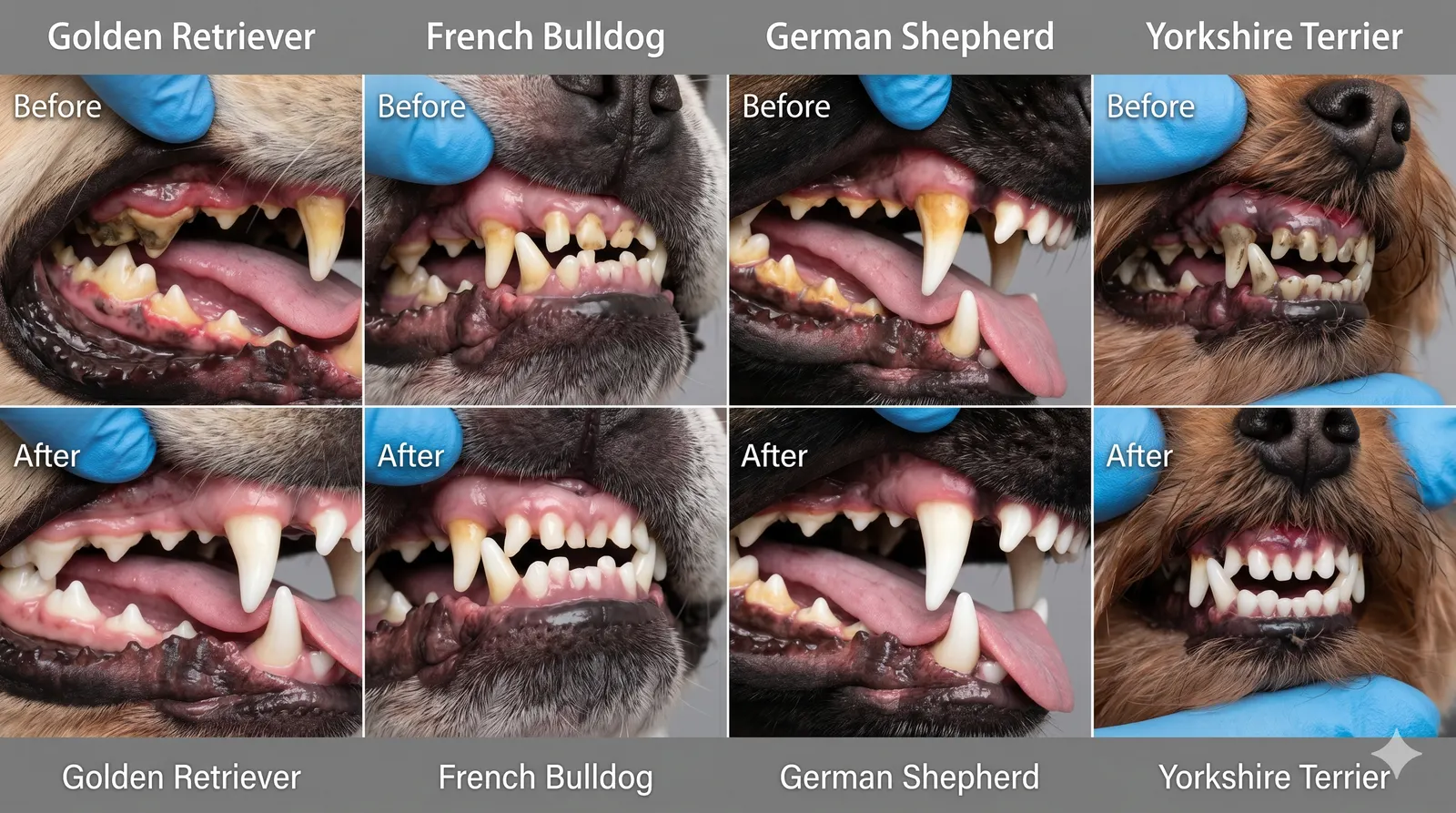
Before & After a Clix COHAT

The same pet, same day — tartar, staining, and gum inflammation removed during a single Comprehensive Oral Health Assessment and Treatment (COHAT) under general anesthesia. Fresher breath, healthier gums, and a full set of digital X-rays on record.

Before and after photo of a dog's teeth following a professional COHAT dental cleaning at Clix Family Hospitals in St. Louis — heavy tartar buildup on the left, clean polished teeth and healthy gums on the right.

Actual Clix Family Hospitals patient. Results shown are typical for a professional cleaning with full-mouth digital radiographs performed under general anesthesia.

Recovery

Recovery Timeline

Here is exactly what to expect in the days after a professional dental cleaning or oral surgery.

  1. Day 0 (procedure day)

    Wake-up & discharge

    Your pet rests in recovery with a dedicated technician until fully awake. Pickup is typically 3–6 PM. Expect grogginess, reduced appetite, and occasional panting for the first evening — all normal anesthesia effects. Offer a small soft meal 2 hours after arriving home.

  2. Days 1–3

    Return to normal

    Most pets eat, drink, and move normally by day 2. If extractions were performed, stick to soft food (canned or kibble soaked in warm water) and give prescribed pain meds on schedule. Skip chew toys, hard treats, and tug games.

  3. Days 4–10

    Healing phase

    Gum tissue closes over extraction sites. Continue soft food, avoid brushing the treated area, and keep an eye out for swelling, bleeding, or bad odor — call us right away if anything looks off.

  4. Days 10–14

    Complimentary recheck

    We examine the mouth at no charge to confirm everything has healed as expected. Normal diet and chew toys usually resume at this visit, and we map out your pet's home-care routine so tartar stays off as long as possible.

Transparent Pricing

Dental Pricing by Disease Grade

We stage every mouth at the start of the procedure using AVDC periodontal disease grading. Once X-rays and probing are complete, we call you with an exact estimate before any treatment begins — no surprise charges.

Grade 1

Routine Cleaning (Mild Gingivitis)

$350–$450

  • Pre-anesthetic bloodwork
  • IV catheter & fluids
  • Full-mouth digital X-rays
  • Ultrasonic scaling + polish
  • Fluoride treatment
  • Follow-up recheck

Grade 2

Early Periodontal Disease

$500–$650

  • Everything in Grade 1
  • Subgingival scaling & root planing
  • Local nerve blocks
  • Take-home pain medication
  • Detailed dental charting

Grade 3

Moderate Periodontal Disease

$650–$900

  • Everything in Grade 2
  • 1–4 surgical extractions
  • Antibiotic therapy
  • Doxirobe gel or bone graft if indicated
  • Soft-food transition plan

Grade 4

Advanced Disease / Oral Surgery

$900–$1,800+

  • Everything in Grade 3
  • Multiple or full-mouth extractions
  • Oronasal fistula repair if needed
  • Extended anesthesia monitoring
  • Recheck at 10–14 days

What Affects Your Estimate

  • Severity of dental disease (Grade 1–4)
  • Number of extractions and oral surgery needed
  • Pre-anesthetic bloodwork and IV fluids
  • Take-home pain medication and antibiotics
  • Clix Wellness Membership discount (10% to 15% off, by plan)

Our Transparency Promise

We call you with an itemized estimate after X-rays and probing — before any treatment begins. No surprises, ever.

Clix Wellness Members save 10% to 15% on procedures, depending on their plan. Learn about membership →

Serving St. Louis Metro

Dental Care for Pets Across the St. Louis Area

Clix Family Hospitals is located at 601 E. Lockwood Ave., Webster Groves, MO 63119, just south of Forest Park and minutes from I-64/Highway 40. Pet parents regularly travel to us for dental care from across the metro area, including:

  • Central West End
  • The Hill
  • Forest Park Southeast
  • Clayton
  • Maplewood
  • Webster Groves
  • Kirkwood
  • Brentwood
  • Richmond Heights
  • University City
  • Dogtown
  • Tower Grove
  • Ballwin
  • Chesterfield
  • Creve Coeur
Address
601 E. Lockwood Ave., Webster Groves, MO 63119
Hours
Mon–Fri 7am–7pm
Sat 8am–4pm
Sun 10am–2pm
Accreditation
AAHA Accredited · Fear Free Certified

Tailored Care

Dental Care by Species & Breed

Dogs

Dogs have 42 adult teeth and are most prone to fractured carnassials (upper 4th premolar), tartar on the cheek teeth, and slab fractures from bones or antlers. Small breeds develop periodontal disease roughly 5× more often than large breeds due to tooth crowding.

Cats

Cats have 30 adult teeth and are uniquely prone to feline tooth resorption — a painful condition affecting 30–70% of adult cats where the tooth is reabsorbed into the jaw. Resorptive lesions are usually invisible without dental X-rays and always require extraction.

Breed-Specific Guidance

Small breeds (Yorkies, Chihuahuas, Dachshunds, Maltese, Pomeranians)
Tooth crowding + smaller jawbone = 5× higher periodontal disease risk. Plan on cleanings every 6–9 months starting at age 2–3.
Brachycephalic breeds (French Bulldogs, Bulldogs, Pugs, Boston Terriers, Persian cats)
Crowded, rotated, and sometimes missing teeth trap plaque. Narrower airways require brachycephalic-specific anesthesia protocols, which our team uses as standard.
Large breeds (Labradors, Goldens, German Shepherds)
Lower periodontal risk but higher fracture risk from aggressive chewing. Annual X-rays are important to catch hidden slab fractures on the upper premolars.
Senior pets (dogs 7+, cats 10+)
Age-related tartar plus reduced immune response accelerates disease. Pre-anesthetic bloodwork is always performed, and we coordinate dental plans with any kidney, cardiac, or endocrine conditions.

At-Home Prevention

At-Home Dental Care for Dogs & Cats

Professional cleanings remove existing tartar — at-home care is what keeps it from coming back. Daily prevention can add years between cleanings.

Daily tooth brushing

The gold standard. Use a pet-safe enzymatic toothpaste (CET Poultry, Virbac C.E.T., or similar — never human toothpaste, which often contains xylitol or fluoride that is toxic to pets) and a soft finger brush or pet toothbrush. Focus on the outer surfaces of canines and upper molars.

VOHC-approved dental chews

Look for the Veterinary Oral Health Council Seal of Acceptance — Greenies, OraVet, Virbac C.E.T. Chews, and Purina DentaLife are all VOHC-tested to reduce plaque and tartar.

Prescription dental diets

Hill's t/d and Royal Canin Dental are clinically proven kibbles with a unique fiber matrix that scrubs the tooth surface as your pet chews.

Water additives

HealthyMouth and similar VOHC-accepted additives add a tasteless enzyme to drinking water that inhibits plaque bacteria — great for pets that resist brushing.

Dental wipes

A middle-ground option for pets that tolerate finger contact but not a brush. Use after meals, focusing on the gumline.

Avoid these

Skip bones, antlers, hooves, hard nylon chews, and ice cubes — they are the leading cause of fractured carnassial teeth in dogs. Tennis balls also abrade enamel over time.

Product references are illustrative — always confirm with your veterinarian before adding a new product to your pet's routine. Look for the VOHC Seal of Acceptance .

Meet Your Care Team

Veterinarians Leading Dental Care at Clix

You'll never wonder who is handling your pet's care. Every dental care procedure at Clix Family Hospitals is performed by a named, credentialed veterinarian with specific training in this area.

Portrait of Dr. Sarah Chen, DVM

Dr. Sarah Chen, DVM

Medical Director

12+ yrs experience · University of Missouri College of Veterinary Medicine

Dr. Chen leads dental anesthesia protocols at Clix and personally reviews every set of full-mouth dental radiographs. Her internal-medicine background shapes how she approaches the mouth — she treats periodontal disease as a whole-body problem, coordinating dental plans with kidney, cardiac, and endocrine care in senior patients.

"What looks like bad breath on the surface is almost always a hidden abscess, fractured tooth, or bone loss underneath. My job is to find it on the X-ray before your pet is in pain."

Oversees 600+ COHATs annually at Clix Family Hospitals

Specialty training & credentials

  • • AVDC-aligned COHAT protocol lead
  • • Advanced continuing education in veterinary dental radiograph interpretation
  • • Fear Free Certified anesthesia handling
  • • AAHA Dental Care Guidelines trained
Portrait of Dr. Marcus Williams, DVM

Dr. Marcus Williams, DVM

Associate Veterinarian

8+ yrs experience · Tuskegee University College of Veterinary Medicine

Dr. Williams handles the surgical side of the dental suite — complex extractions, oronasal fistula repair, and mandibular fracture stabilization. His orthopedic background means he thinks about the jaw as a load-bearing structure, which matters a lot when you are removing canine teeth or repairing bone in a small-breed mouth.

"A good extraction is a quiet one. When we take the time to use proper nerve blocks and surgical technique, pets wake up comfortable and eat dinner that same night."

400+ dental surgical procedures performed at Clix

Specialty training & credentials

  • • Advanced training in oral surgery and extractions
  • • Regional nerve-block certification (infraorbital, mental, maxillary, inferior alveolar)
  • • Fear Free Certified
  • • Orthopedic surgical training — Tuskegee University CVM

Real Patients

What St. Louis Pet Parents Say

Dr. Chen was incredible with Benny's dental cleaning. She explained every step beforehand and called us personally after the procedure. Benny was back to his toy-destroying self by the next morning. Best vet experience we've ever had.

Benny · French Bulldog · Chesterfield

Seen by Dr. Sarah Chen

Peanut is 11 and I was terrified of anesthesia. Dr. Chen spent 20 minutes walking me through the monitoring protocol and pre-anesthetic bloodwork. She called with the X-ray findings mid-procedure before touching anything I hadn't approved. Four extractions later, Peanut eats kibble again and has fresh breath for the first time in years.

Peanut · Yorkie · Kirkwood

Seen by Dr. Sarah Chen

Brachycephalic breeds and anesthesia scare me. Dr. Williams explained exactly how their protocol is different for Frenchies — it made all the difference. Mochi went in with stinky breath and two wiggly teeth, came home the same day, and was snoring on the couch by 7 PM like nothing happened.

Mochi · French Bulldog · The Hill

Seen by Dr. Marcus Williams

Frequently Asked

Dental Care FAQs

At Clix Family Hospitals, a routine dental cleaning (Grade 1, mild gingivitis) runs $350 to $450 and includes pre-anesthetic bloodwork, IV fluids, full-mouth digital X-rays, ultrasonic scaling, polishing, and a follow-up recheck. Early to moderate periodontal disease, including up to four surgical extractions, runs $500 to $900 (Grades 2 and 3), and advanced disease or oral surgery runs $900 to $1,800 or more (Grade 4). Clix Wellness Members save 10% to 15% on dental procedures, depending on their plan.
Yes — a professional cleaning under anesthesia is the only way to remove tartar beneath the gumline, capture dental X-rays, and assess each tooth for disease. Brushing and chews help slow plaque buildup, but they cannot reverse existing periodontal disease. The AVDC and AAHA consider annual professional cleanings part of standard preventive care.
Anesthesia lets us perform a complete, pain-free cleaning — including subgingival (below-gum) scaling, full-mouth digital X-rays, and precise probing of each tooth. It also protects the airway from aspiration, keeps your pet still for delicate instruments, and allows us to treat painful findings in the same visit. The AVDC has formally opposed anesthesia-free dentistry since 2004.
No, it is not considered safe or effective by the American Veterinary Dental College or the AAHA. Anesthesia-free cleanings only remove visible plaque above the gumline, miss the 60% of disease that lives below it, cannot capture dental X-rays, and can be painful or traumatic for conscious pets. We only offer professional cleanings performed under general anesthesia with full monitoring.
Modern veterinary anesthesia is very safe — studies cite anesthetic mortality at roughly 0.05% in healthy dogs and 0.11% in healthy cats. Every Clix dental patient receives pre-anesthetic bloodwork, an IV catheter with fluids, body-temperature support, and continuous monitoring of ECG, blood pressure, SpO2, CO2, and temperature by a dedicated technician.
Most adult dogs and cats benefit from an annual professional dental cleaning. Small breeds, brachycephalic (flat-faced) breeds, and seniors often need cleanings every 6–9 months because their mouths accumulate plaque faster and are more prone to tooth crowding.
Common signs include persistent bad breath (halitosis), red or bleeding gums, yellow or brown tartar, drooling, dropping food, pawing at the mouth, chewing on one side, loose or missing teeth, and facial swelling. Pets often hide dental pain, so absence of symptoms does not mean absence of disease.
COHAT stands for Comprehensive Oral Health Assessment and Treatment. It is the AVDC-recommended term for a modern veterinary dental procedure that includes full-mouth digital X-rays, a tooth-by-tooth probing exam, ultrasonic scaling, polishing, and treatment of any disease found — all performed in one anesthetized visit.
Plan on a full-day stay. Drop-off is between 7:00–8:00 AM, the procedure itself takes 60–120 minutes (longer with extractions), and most pets are ready for pickup by late afternoon once anesthesia has fully worn off and a doctor has reviewed discharge instructions with you.
Most pets are back to normal within 24–48 hours after a routine cleaning. If extractions were performed, we recommend soft food and reduced activity for 10–14 days while the gum tissue heals. We include a complimentary recheck and provide detailed written aftercare instructions.
Fast your pet after 10 PM the night before (water is fine). Drop-off is 7:00–8:00 AM, we call after the oral exam and X-rays with a treatment plan and revised estimate, and pickup is typically between 3:00 and 6:00 PM. You'll leave with pain meds if needed, written instructions, and a direct line to call overnight.
Most accident-and-illness pet insurance plans cover dental disease treatment (extractions, oral surgery) but consider routine preventive cleanings an add-on wellness benefit. Our team can provide itemized invoices for insurance reimbursement and will help you confirm coverage before your appointment.
Yes. Yorkies, Chihuahuas, Dachshunds, Maltese, Pomeranians, and other small breeds under ~15 lbs are up to five times more likely to develop periodontal disease than giant breeds (Banfield Applied Research; Wallis & Holcombe, JSAP 2020). They have the same 42 teeth as a Labrador but far less jawbone to support them. We often recommend cleanings every 6–9 months for small breeds.
Yes. Flat-faced breeds have crowded, rotated, and sometimes missing teeth that trap plaque, plus narrower airways that make anesthesia require extra planning. Our team uses brachycephalic-specific anesthesia protocols, close airway monitoring, and typically recommends more frequent cleanings.
Absolutely. Most cats show signs of periodontal disease by age 3 (AVMA), and cats are uniquely prone to tooth resorption — a painful condition where the tooth is reabsorbed into the jaw and requires extraction. Cats are experts at hiding pain, so X-rays under anesthesia are often the only way to catch these problems.
Yes. Banfield State of Pet Health data show dogs with advanced periodontal disease are 2.3× more likely to develop chronic kidney disease and 6.3× more likely to develop endocarditis; cats show a 1.5× increase in CKD risk. Treating periodontal disease can measurably improve inflammatory markers and quality of life, especially in senior pets.
Start slow: let your pet taste pet-safe enzymatic toothpaste (never human toothpaste — xylitol and fluoride are toxic) off your finger, then introduce a soft finger brush or pet toothbrush. Aim for 30 seconds per side, daily if possible. Focus on the outer surfaces of the canines and upper molars where plaque accumulates fastest.
We recommend products carrying the VOHC (Veterinary Oral Health Council) Seal of Acceptance — including CET enzymatic toothpaste, Greenies dental treats, Oravet chews, Hill's t/d dental diet, and Healthymouth water additive. No single product replaces a professional cleaning, but they meaningfully slow plaque buildup between visits.

Ready to Book Dental Care?

Schedule online in under 2 minutes or give us a call.